A Practical MRT Navigation Guide for Daily Commuters in Singapore
Singapore's Mass Rapid Transit system is one of the densest urban rail networks in Southeast Asia. Six colour-coded lines — North-South (red), East-West (green), North East (purple), Circle (orange), Downtown (blue), and Thomson-East Coast (brown) — connect 141 stations across 230 kilometres of track. For residents without a car, the MRT is the backbone of daily movement.
Understanding the Six Lines
The North-South Line (NSL) runs from Jurong East to Marina South Pier, passing through Orchard, City Hall, and Bishan. It is the oldest line, opened in 1987, and remains one of the busiest during weekday mornings. The East-West Line (EWL) connects Tuas Link to Pasir Ris with a branch to Changi Airport — this is the line most visitors use on arrival.
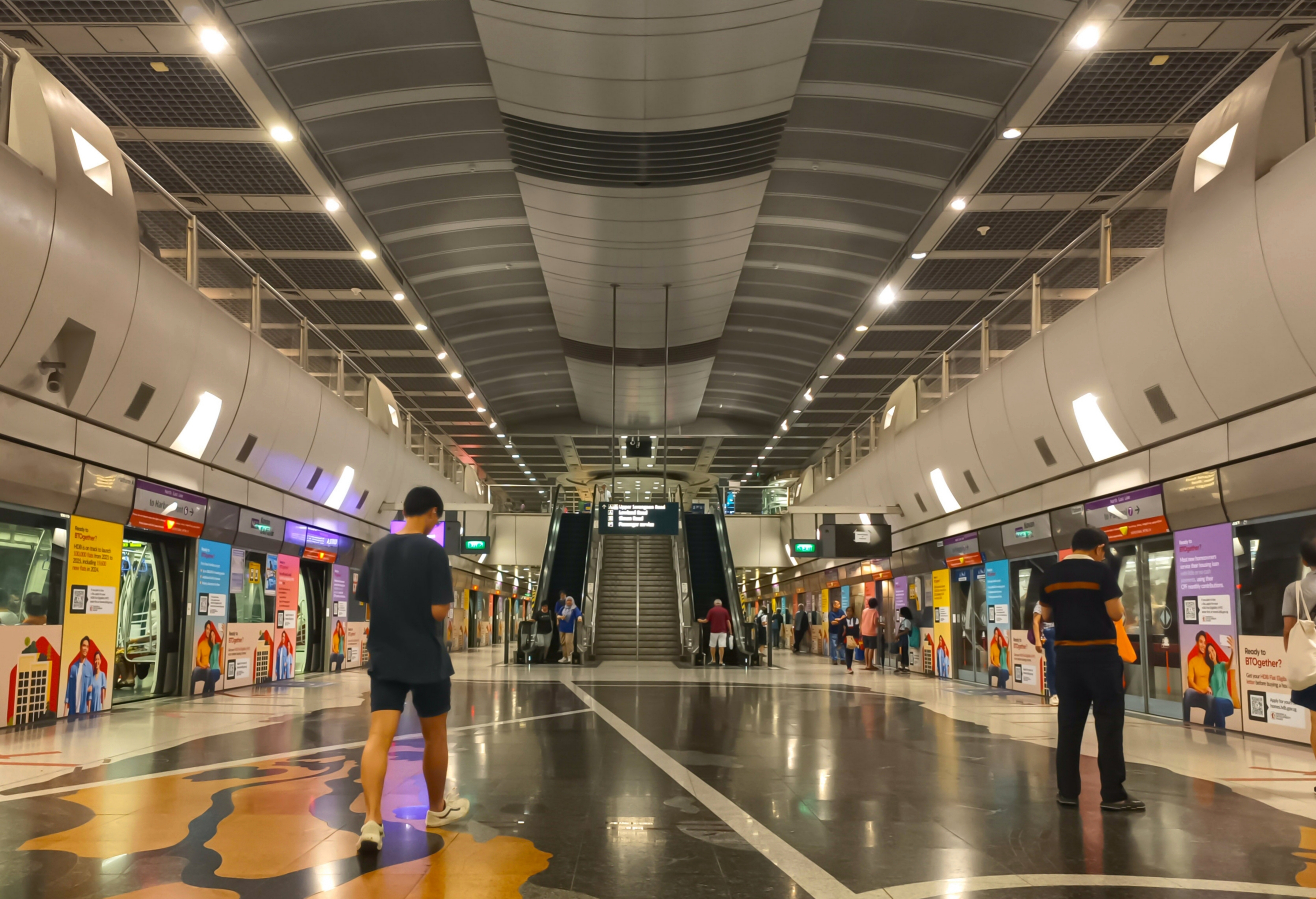
The North East Line (NEL), fully underground, links HarbourFront to Punggol through Chinatown and Little India. The Circle Line (CCL) loops through Buona Vista, Holland Village, Botanic Gardens, and Bayfront, making it particularly useful for cross-island trips that would otherwise require changing lines twice.
Two newer additions — the Downtown Line (DTL) and the Thomson-East Coast Line (TEL) — have significantly reduced travel times. The DTL runs from Bukit Panjang to Expo through the CBD, while the TEL, still being extended in stages, serves Woodlands, Caldecott, and the Stevens corridor.

Fare Structure and Payment Methods
MRT fares are distance-based, starting at SGD 0.99 for trips under 3.2 kilometres and capping at SGD 2.21 for the longest possible journeys. Payment is via stored-value cards: the EZ-Link card and NETS FlashPay are the most common. Since 2019, contactless bank cards (Visa and Mastercard) and mobile wallets such as Apple Pay and Google Pay are accepted directly at fare gates.
A key cost-saving mechanism is the transfer rebate. If you tap out of a bus or MRT station and tap into another within 45 minutes, the system treats both legs as a single journey. This can reduce fares by SGD 0.30 to SGD 0.50 per trip, which adds up to SGD 10–15 monthly for regular commuters.
The monthly concession pass (Adult Monthly Travel Pass, or AMTP) costs SGD 128 for unlimited MRT and bus rides. It becomes cost-effective if you spend more than SGD 6.40 per day on public transport — roughly two round trips of medium distance.
Peak-Hour Strategy
Morning rush runs from roughly 7:30 to 9:00 AM. The most congested interchange stations during this window are Bishan (NSL/CCL), Jurong East (NSL/EWL), and Dhoby Ghaut (NSL/NEL/CCL). Trains arrive every 2 to 3 minutes on major lines during peak, but platforms at these stations fill to capacity.
The Land Transport Authority's Free Pre-Peak Travel scheme, introduced in 2013, offered free rides for commuters tapping out at designated CBD stations before 7:45 AM. While the scheme has been modified over the years, travelling before 7:30 AM consistently means shorter platform waits and a seat for the journey.
Evening peak (5:30 to 7:30 PM) is marginally less packed than mornings at most stations. One practical workaround: if your destination has two nearby stations (for example, Tanjong Pagar and Maxwell on the TEL), choosing the less popular one can save 5 to 8 minutes of platform queueing.
Interchange Shortcuts Worth Knowing
Several station interchanges have significantly different walking distances depending on which platform exit you use. At Bugis (EWL/DTL), the cross-platform transfer takes under a minute if you position yourself at the rear of a westbound EWL train. At Botanic Gardens (CCL/DTL), the transfer corridor is notably long — allow at least 4 to 5 minutes.
At Raffles Place, the NSL and EWL platforms are stacked vertically. Commuters heading from the NSL to the EWL can cut transfer time by standing near the centre of the platform, directly above the EWL escalator bank.
Last-Mile Connectivity
Getting from the MRT station to your final destination — the "last mile" — is where many car-free commuters face friction. Several options address this:
Feeder buses: SBS Transit and SMRT operate short-loop services connecting MRT stations to nearby HDB estates. These typically run every 8 to 12 minutes and cost SGD 0.77 to SGD 0.92.
Shared bicycles: Operators like Anywheel and SG Bike maintain docking stations near MRT exits. A 30-minute ride costs SGD 0.50 to SGD 1.00. Availability is best at stations outside the CBD where bicycle docks are larger.
Walking: Singapore's sheltered walkway programme has connected major MRT stations to nearby bus interchanges, schools, and housing blocks with covered pedestrian paths. In Toa Payoh, Ang Mo Kio, and Tampines, these walkways extend up to 400 metres from station exits.
Useful External References
- Land Transport Authority (LTA) — official information on fares, routes, and infrastructure
- TransitLink — fare calculator and route planner
- SMRT Corporation — operator of the North-South, East-West, Circle, and Thomson-East Coast Lines
Related reading: E-Scooter Rules and Where to Ride | Carpooling and Ride-Sharing Alternatives